Key Takeaways
- Independent medical examinations (IMEs) in Georgia workers’ compensation cases assess workplace injuries, treatment needs, work restrictions, and eligibility for benefits.
- Employers can require injured workers to attend IMEs at reasonable times and locations, with at least 10 days’ written notice and advance payment of travel expenses.
- Qualifying injured workers can request one employer-paid IME with a physician they select by providing written notice within 120 days of receiving income benefits.
- Preparing for an IME includes reviewing medical records, documenting symptoms, and answering questions truthfully about injuries, treatment, and daily limitations.
- An unfavorable IME report may lead to disputes over medical treatment or disability benefits, but the report itself doesn’t terminate benefits without a judge’s decision.
- Perkins Studdard helps injured workers in Carrollton, LaGrange, and surrounding communities challenge unfavorable IME findings and protect their workers’ compensation benefits.
If you’ve suffered a workplace injury in Carrollton or LaGrange, you may be asked to attend an independent medical examination (IME) before or after being granted workers’ comp benefits. During the IME appointment, a doctor evaluates you and provides an opinion about your injury severity, treatment needs, and ability to return to work. As you can imagine, the findings can impact your medical treatment and benefits.
Receiving an IME notice can be worrying. Does this mean your employer thinks you’re faking your condition? Will the doctor interpret all findings in the company’s favor? In this guide, we explain what happens during an independent medical examination in Carrollton or LaGrange, as well as your rights under state law.
What Is an Independent Medical Examination in Georgia Workers’ Compensation?
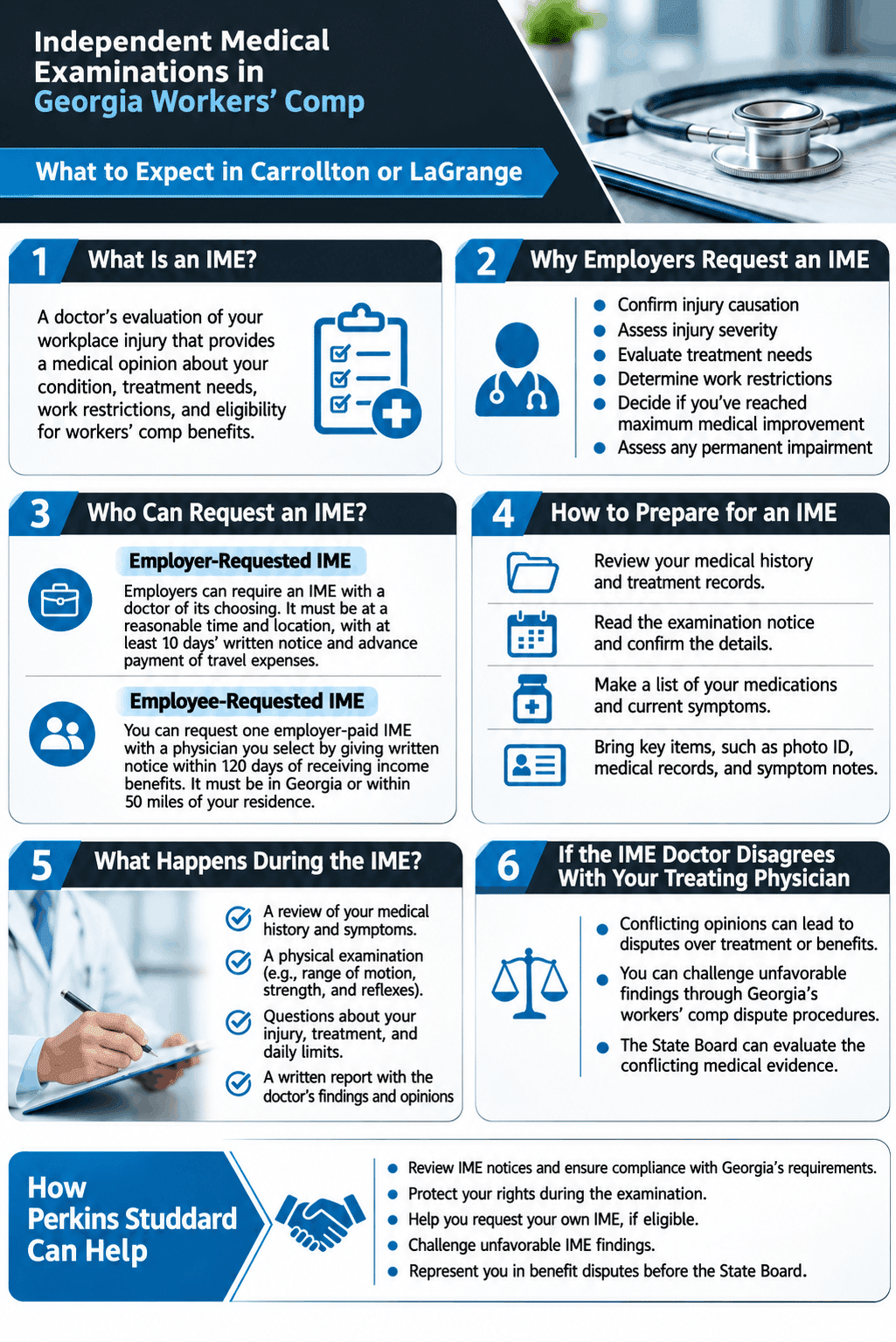
An independent medical examination (IME) is an evaluation conducted to assess your work-related injury. Unlike an appointment with your treating doctor, an IME is intended to get a medical opinion rather than provide ongoing treatment. Under O.C.G.A. § 34-9-202, your employer can ask you to attend an examination with a qualified physician of its choosing.
Why Are Independent Medical Examinations Requested?
Your employer or its insurance company may request an IME to obtain another medical opinion about your condition. The examining physician may evaluate:
- Injury Causation: Did your workplace accident cause or contribute to your medical condition?
- Injury Severity: How extensive are your injuries, and how do they affect your ability to function?
- Medical Treatment: Do you need further treatment, diagnostic tests, or rehabilitation?
- Work Restrictions: Can you return to your regular job, or do you need modified duties?
- Maximum Medical Improvement (MMI): Has your condition reached the point where further treatment isn’t expected to produce substantial improvement?
- Permanent Impairment: Has your injury caused lasting loss of bodily function?
How Does an IME Differ From a Regular Medical Appointment?
At a regular medical appointment, your authorized treating physician prescribes medical treatment and monitors your recovery. An IME physician evaluates your condition and prepares his or her findings for the requesting party. If the IME physician’s conclusions are different from your treating doctor’s recommendations, disputes may arise over your medical care, work restrictions, and disability benefits.
Who Can Request an Independent Medical Examination?
Georgia workers’ compensation law gives both employers and injured employees the right to request independent medical examinations. However, the rules differ depending on who requests the examination.
Employer-Requested Independent Medical Examinations
When your employer asks you to undergo an examination with a doctor of its choosing, the IME examination must take place at a reasonable time and location. In some cases, your employer’s insurance company may arrange the appointment to get another medical opinion about your injuries, treatment needs, or ability to work.
Your employer can request multiple examinations during your workers’ compensation claim. However, each request must be reasonable. Board Rule 202(c) requires your employer to provide at least 10 days’ written notice of the IME examination, along with advance payment of travel expenses. These benefits include mileage at $0.45 per mile, reasonable transportation costs, and, when appropriate, meal and lodging expenses.
Employee-Requested Independent Medical Examinations
You have the right to one employer-paid examination with a physician you select if your injury has been accepted as compensable and you’ve received income benefits. If you intend to exercise this right, you must notify your employer or its insurance company in writing within 120 days of receiving income benefits.
The examination must take place at a reasonable time and location within Georgia or within 50 miles of your residence. You can use this assessment to get another medical opinion if you disagree with your treating physician’s diagnosis, recommended treatment, or opinion of your ability to return to work.
How Should You Prepare for an Independent Medical Examination?
Preparing for your independent medical examination helps you provide accurate information about your workplace injury, medical treatment, and current limitations.
Review Your Medical History and Treatment Records
Start by reviewing the treatment you’ve received since your workplace accident, including diagnoses, imaging results, medications, therapy, and restrictions imposed by your treating physician. Pay attention to how your symptoms have changed since the injury and how they affect your ability to work and perform daily activities.
Your medical history may also include injuries or conditions that existed before your workplace accident. Be prepared to discuss these conditions, particularly if they affect the same part of your body as your injury at work. Answer all questions truthfully, including those concerning symptoms that have improved or resolved.
Know What to Bring to Your Appointment
Once you’ve reviewed your medical history, gather the information you’ll need for your appointment. Bring the following items:
- Photo identification
- Appointment information
- Medication list
- Medical records
- Symptom notes
Having this information available will help you answer the doctor’s questions and better describe how your injury affects your daily life. Sometimes, the examination notice may also request that you bring other information such as diagnostic testing films and reports.
Review the Examination Notice
Review the examination notice as soon as you receive it. Confirm the appointment date, time, and location, and make arrangements for transportation. If you have scheduling conflicts or medical restrictions that prevent you from attending, contact the insurance company or your workers’ compensation attorney before the examination.
Don’t ignore the notice or assume you can reschedule the appointment without permission. Under O.C.G.A. § 34-9-202(c), refusing or obstructing a required examination without sufficient justification can jeopardize your workers’ compensation benefits. Insurance companies will also often seek to make you pay cancellation fees associated with missed IME appointments.
What Happens During a Workers’ Compensation Independent Medical Examination?
The examination usually begins with questions about your workplace accident and the treatment you’ve received. The physician or someone in the physician’s office may ask you to describe:
- How the injury occurred and which parts of your body were affected.
- The pain, mobility problems, or other symptoms you experienced after the accident.
- The medications, therapy, surgeries, and other treatments you’ve received.
- Your pain levels, mobility restrictions, and difficulties performing daily activities.
- Earlier injuries or medical problems involving the affected body parts.
Answer these questions truthfully and explain how your symptoms have changed during recovery. If you experience pain only during certain activities, describe those activities rather than suggesting the pain is constant.
After discussing your medical history, the physician may perform tests to assess your injuries. Depending on your condition, these may include range-of-motion measurements, muscle strength testing, reflex checks, and evaluations of your ability to move. Tell the examiner if a movement causes pain or you’re unable to complete it safely.
Finally, the physician may also assess your ability to lift, stand, walk, bend, or perform tasks required by your job. These findings help determine if you can return to your regular duties or need restrictions on certain activities. For example, if you injured your back while lifting equipment, the doctor may evaluate your lifting ability and restrictions on bending or standing.
What Happens After an Independent Medical Examination?
Following your IME, the examining physician prepares a medical report documenting their findings. Your employer or its insurance company may use this report to evaluate your claim, particularly if questions remain about your medical treatment or ability to return to work.
The physician’s report summarizes your medical history, examination results, and conclusions about your work-related injury. Depending on the purpose of the examination, the report may address:
- Injury Causation: The relationship between your workplace accident and diagnosed medical condition.
- Medical Treatment: The need for additional testing, surgery, therapy, or other treatment.
- Work Restrictions: Your ability to perform regular duties or return to work with restrictions.
- Maximum Medical Improvement: The point at which further treatment isn’t expected to produce substantial improvement.
- Permanent Impairment: Any lasting loss of bodily function resulting from your injury.
Once the report is completed, the insurance company may compare the findings with your authorized treating physician’s recommendations. Disagreements between the doctors can lead to disputes concerning your treatment and benefits.
However, an unfavorable IME report doesn’t terminate your benefits by itself. The insurance company must follow Georgia’s workers’ compensation rules when changing or suspending payments. If the physicians disagree, their medical opinions may be considered during proceedings before the Georgia State Board of Workers’ Compensation.
How Can a Georgia Workers’ Compensation Lawyer Help With an IME?
If the examining physician disagrees with your treating doctor, your employer’s insurance company may use those findings to challenge your claim. At Perkins Studdard, we help injured workers in Carrollton, LaGrange, and surrounding West Georgia communities protect their rights during IME disputes.
Our workers’ compensation attorneys can assist you by:
- Reviewing Examination Notices: Checking that your employer has followed Georgia’s requirements for advance notice, reasonable scheduling, and travel expenses.
- Protecting Your Examination Rights: Addressing disputes involving appointment locations, medical restrictions, and requests to reschedule.
- Requesting Your Own IME: Determining if you qualify for an employer-paid examination with a physician you select under O.C.G.A. § 34-9-202(e).
- Challenging Unfavorable Findings: Comparing the IME report with your treatment records, diagnostic tests, and authorized treating physician’s recommendations.
- Representing You in Benefit Disputes: Presenting medical evidence and advocating for your continued medical treatment and disability payments before the Georgia State Board of Workers’ Compensation.
We can also help you respond if an insurance company attempts to reduce or suspend your benefits based on an IME report. Our attorneys will examine the medical evidence and the insurer’s actions to determine how to challenge an unfavorable decision.
FAQs About Independent Medical Examinations in Georgia Workers’ Comp
Can You Refuse an Independent Medical Examination in Georgia?
Refusing or obstructing an employer-requested IME without sufficient justification can jeopardize your workers' compensation benefits. Your employer has the right to require an examination at a reasonable time and location, provided it follows Georgia's notice and travel expense rules.
If you refuse to attend or interfere with the examination, your right to compensation may be suspended until you cooperate. If you can't attend because of a medical restriction, transportation problem, or scheduling conflict, contact the insurance company or your attorney before the appointment. Explain the problem and request another date or location rather than ignoring the examination notice.
What Should You Do If the IME Doctor Disagrees With Your Treating Physician?
An IME physician may reach conclusions that differ from your treating doctor's findings. For example, your treating physician may recommend ongoing therapy and restrictions on lifting, while the IME physician concludes that you can return to your regular duties. These conflicting opinions can lead to disputes over medical treatment and disability benefits.
If the IME physician disagrees with your treating doctor, review the findings with your workers' compensation attorney. Your attorney can compare both medical opinions, identify disagreements, and determine what other evidence may help your claim. Your authorized treating physician may also review the IME report and provide an explanation supporting their diagnosis, treatment recommendations, or work restrictions.
An unfavorable IME report doesn't mean you must accept the examining physician's conclusions. You can challenge those findings through the workers' compensation dispute procedures, and the Georgia State Board of Workers’ Compensation can evaluate conflicting medical evidence when deciding your entitlement to benefits.
Questions About Independent Medical Examinations?
If you’ve received an IME notice or disagree with the examining physician’s findings, it’s important to know your rights and how to challenge medical opinions that could jeopardize your benefits.
At Perkins Studdard, we represent injured workers in Carrollton, LaGrange, and throughout West Georgia. Our workers’ compensation attorneys can review your examination notice, address disputes over medical findings, and fight for the benefits you’re entitled to receive. To schedule a free and confidential consultation, call our law firm at (770) 285-0548.