Key Takeaways
- Georgia’s workers’ compensation system protects many injured construction workers. If you’re hurt while performing construction work, you may qualify for medical bill payment and wage replacement benefits.
- Working for a subcontractor doesn’t automatically prevent you from receiving benefits. Your employer usually provides workers’ compensation coverage, but a principal contractor may be responsible if an uninsured subcontractor fails to carry the required insurance.
- An independent contractor label doesn’t always decide your legal status. Georgia courts look at the working relationship, including who controlled the time, manner, and method of the work, to decide if a worker qualifies as an employee.
- Catastrophic injuries may qualify for additional benefits. Serious injuries such as paralysis, amputations, severe traumatic brain injuries, blindness, and severe burns may meet Georgia’s statutory definition of a catastrophic injury and extend the benefits available.
- You may have both a workers’ compensation claim and a third-party lawsuit. If a property owner, another contractor, or an equipment manufacturer contributed to your injury, you may be able to pursue a negligence claim while receiving workers’ compensation benefits.
According to the U.S. Bureau of Labor Statistics, construction workers suffer workplace injuries at a higher rate than employees in many other industries. This includes falls, scaffolding accidents, building collapses, and more. Even when your mind is on good safety practices at all times, all it can take is a hazardous job site or an act of negligence to leave you with serious injuries.
Georgia’s workers’ compensation system provides medical and wage benefits for many injured construction workers, but construction claims can be complicated. For example, you may work for a subcontractor on a general contractor’s job site, receive your paycheck through a staffing company, or be classified as an independent contractor. In some cases, another contractor, a property owner, or the manufacturer of defective equipment may share responsibility for the accident.
This article explains how workers’ compensation law applies to construction workers in Georgia. It also explains Georgia’s catastrophic injury designation, the relationship between workers’ compensation claims and third-party negligence claims, and the steps you should take after a construction accident.
Why Construction Workers Are Injured at Higher Rates
Construction sites are inherently dangerous places. A single location can contain:
- Elevated work areas
- Heavy equipment and machinery
- Electrical systems
- Excavation work
- Power tools
Conditions also change as projects progress. Crews begin new phases of work, equipment is relocated, materials are delivered, and different trades work in the same space. This means that a safe work area in the morning may contain new hazards by the afternoon. You can follow your employer’s safety practices and still be injured by another company’s actions or by a dangerous condition elsewhere on the site.
Here’s a closer look at the various risks that make construction such a risky profession:
- Falls From Heights: Falls remain one of the leading causes of fatal and nonfatal injuries in the construction industry. Workers can fall from roofs, ladders, scaffolding, aerial lifts, platforms, structural steel, or unprotected floor openings. Missing guardrails, damaged ladders, unsecured walking surfaces, and inadequate fall protection all increase the risk of a life-changing accident.
- Scaffolding Collapses: Scaffolding gives crews access to elevated work areas, but a failure can be devastating. Collapses may result from improper assembly, missing support components, defective materials, excessive weight, or a lack of inspections. Workers on the scaffold and people below may suffer head injuries, fractures, spinal cord injuries, traumatic brain injuries, or fatalities.
- Struck-By Incidents: A struck-by incident happens when a person is hit by a moving object or vehicle. Falling tools, suspended loads, building materials, forklifts, cranes, dump trucks, and other machinery can all cause these accidents. Depending on the force of the impact, a worker may suffer fractures, crush injuries, traumatic brain injuries, or fatal injuries.
- Equipment Accidents: Power tools and heavy machinery can create hazards for both operators and nearby crews. Excavators, bulldozers, skid steers, loaders, concrete mixers, power saws, nail guns, and hydraulic tools can cause serious injuries if they malfunction, are operated without proper training, or are used in areas where pedestrians and machinery share the same workspace.
- Electrocution: Electrical injuries remain a leading cause of workplace deaths in the construction industry. Contact with overhead power lines, exposed wiring, energized equipment, temporary electrical systems, or damaged extension cords can cause burns, cardiac arrest, nerve damage, traumatic injuries from falls, and death.
The company responsible for workers’ compensation benefits isn’t always the business managing the entire project. That issue becomes especially important when you work for a subcontractor on a general contractor’s job site.
Does Workers’ Compensation Cover Construction Workers in Georgia?
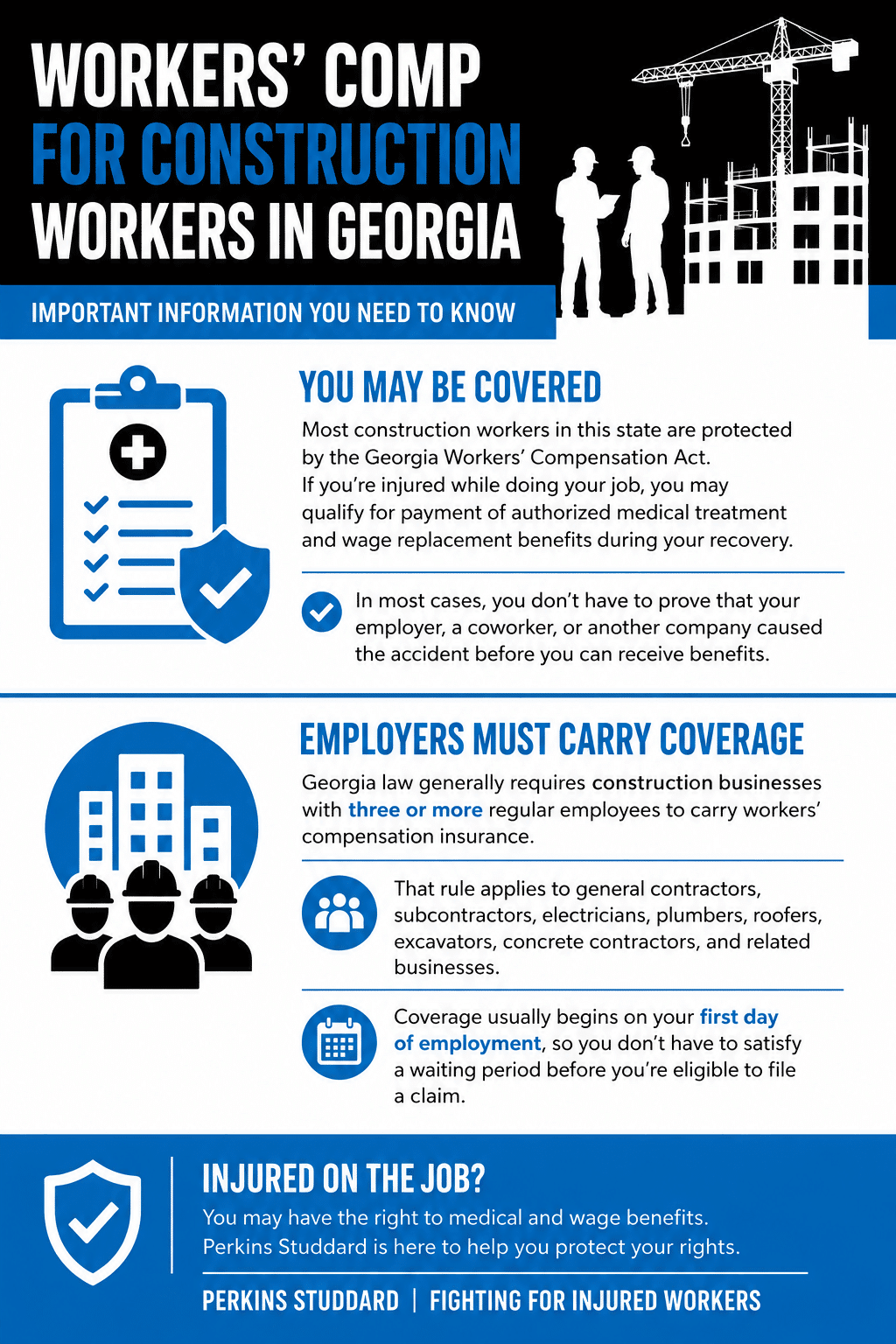
Most construction workers in this state are protected by the Georgia Workers’ Compensation Act. If you’re injured while doing your job, you may qualify for payment of authorized medical treatment and wage replacement benefits during your recovery. In most cases, you don’t have to prove that your employer, a coworker, or another company caused the accident before you can receive benefits.
Georgia law generally requires construction businesses with three or more regular employees to carry workers’ compensation insurance. That rule applies to general contractors, subcontractors, electricians, plumbers, roofers, excavators, concrete contractors, and related businesses. Coverage usually begins on your first day of employment, so you don’t have to satisfy a waiting period before you’re eligible to file a claim.
What Happens if You Work for a Subcontractor?
If your employer is a subcontractor who fails to obtain workers’ compensation insurance, you don’t lose your right to workers’ compensation benefits simply because you’re working on another company’s job site. Under O.C.G.A. § 34-9-8, a principal, intermediate, or subcontractor may become liable for benefits owed to an injured worker employed by a subcontractor. This provision helps prevent you from losing benefits because a lower-tier contractor failed to obtain the required insurance.
Example: Suppose a framing subcontractor hires you to work on a commercial building project but doesn’t carry workers’ compensation insurance. If you’re injured in a fall, you may be able to pursue benefits from the contractor that hired the uninsured subcontractor.
If you work for a subcontractor and suffer a workplace accident, report the injury to your employer as soon as possible, even if the general contractor also completes an incident report. If a superintendent or site superintendent documents the accident, ask for a copy if one is available. You should also keep copies of emails, text messages, or other written communications showing when you reported the injury.
Questions about subcontractor liability frequently lead to another dispute on construction projects: whether the injured worker was truly an employee or was improperly classified as an independent contractor. That classification can determine eligibility for workers’ compensation benefits, which we’ll discuss next.
What if You’re Classified as an Independent Contractor?
Some construction companies classify their workers as independent contractors instead of employees. In some situations, that designation is correct. In others, it doesn’t accurately reflect the working relationship on the job site. Signing an agreement that calls you an independent contractor doesn’t automatically settle your employment status.
Georgia Looks Beyond the Job Title
Georgia courts don’t rely solely on the label used in a contract. One of the main questions is who has the right to control the schedule, manner, and method of the job. If a company directs how you perform your duties instead of simply expecting a completed result, you may qualify as an employee under workers’ compensation law. Courts may also consider who supplied the tools and equipment, how you were paid, who set your schedule, and whether you could accept work from other businesses.
Catastrophic Construction Injuries Under Georgia Workers’ Compensation Law
Under O.C.G.A. § 34-9-200.1(g), a claim qualifies for catastrophic status only if it meets one of the categories established by statute. Examples include:
- Spinal cord injuries resulting in paralysis
- Loss of a hand, arm, foot, or leg
- Severe traumatic brain injuries
- Severe burns
- Blindness
A catastrophic designation can extend the time provided for wage loss and medical benefits. It may also provide access to vocational rehabilitation services if you’re unable to return to your previous occupation. Depending on your condition, your claim may also include future surgeries, rehabilitation, prescription medications, prosthetic devices, wheelchairs, home health assistance, vehicle modifications, home modifications, and other authorized treatment.
Can You File a Third-Party Lawsuit After a Construction Accident?
Workers’ compensation and a third-party negligence claim serve different purposes. A workers’ compensation claim provides certain benefits for an on the job injury through your employer’s workers’ compensation insurance company without requiring proof that someone else was negligent and caused the accident. A third-party personal injury claim seeks compensation from another party whose negligence caused or contributed to your injuries. In some construction accidents, you may have the right to pursue both at the same time.
You Usually Can’t Sue Your Employer
Workers’ compensation is normally the exclusive remedy against your employer for a job-related injury. That means you typically can’t file a personal injury lawsuit against them after receiving employee benefits. But depending on the circumstances, you may have a third-party claim against:
- A property owner that failed to correct or warn about a dangerous condition.
- Another contractor or subcontractor whose negligence caused the accident.
- An equipment manufacturer that produced defective machinery, tools, or safety technology.
- A company responsible for inspecting, maintaining, or repairing equipment used on the project.
- A delivery company whose driver caused an accident on the job site.
Unlike a workers’ compensation claim, a third-party lawsuit requires proof that another party’s negligence or defective product caused your injuries.
Can You Pursue Both Claims at the Same Time?
In many cases, yes. You may receive workers’ compensation benefits while pursuing a separate lawsuit against a negligent third party. The two claims are independent of each other, although they may affect one another as the case moves forward.
For example, workers’ compensation can pay authorized medical expenses and income benefits soon after the accident, while a third-party lawsuit may seek compensation for losses that aren’t available through the system. Georgia law also gives a workers’ compensation insurance company lien rights in some situations if you recover money from the third-party claim. Those issues can affect how a settlement or verdict is distributed.
FAQs About Workers’ Comp for Construction Workers in Georgia
Can You Receive Workers' Compensation Benefits if You Were Partially at Fault for the Accident?
Yes. Georgia's workers' compensation law generally doesn't require you to prove that another person caused your injury before you can qualify for benefits. In many cases, employees remain eligible even if they made a mistake that contributed to the accident.
That said, there are exceptions. For example, benefits may be denied if the injury resulted from intoxication or an intentional act of self-harm. If your employer or its insurance carrier denies your claim because it alleges you caused the accident, an attorney can evaluate the denial and represent you before the Georgia State Board of Workers' Compensation if appropriate.
Can I Choose My Own Doctor After a Construction Injury?
Not always. The system generally requires injured employees to receive treatment from a physician authorized by their employer's workers' compensation insurance. Many employers satisfy this requirement by posting a panel of physicians at the workplace. If they meet the legal requirement, you are often limited to choosing from your employer’s list of doctors.
If your employer does not properly post a panel of physicians, you may be able to choose your own doctor as the authorized treating physician. Receiving treatment from an unauthorized doctor can create disputes over payment, so it's important to understand the rules that apply to your claim.
Talk to a Georgia Workers’ Comp Lawyer About Your Claim
Construction workers face hazards nearly every working day. While Georgia’s workers’ compensation law provides an important source of medical care and income benefits, construction claims may also involve subcontractor liability, employment classification disputes, catastrophic injury status, and third-party negligence claims.
If questions arise about insurance coverage, employment status, or another party’s role in the accident, a workers’ compensation attorney can help. At Perkins Studdard LLC, we represent injured Georgia workers and can help you pursue the benefits and compensation you’ve earned. To schedule a confidential consultation and case evaluation, call our law firm at (770) 285-0548.